This article does two things. It tells you what the research actually says about which parrots talk, using real numbers instead of the same recycled top-ten lists. And it tells you plainly what owning one of these birds involves, so you can decide with your eyes open.
With that said, the differences between species are real and measurable.
The study found grey parrots had the largest repertoires by a clear margin, averaging around 60 human words (Benedict et al., 2022). Cockatoos, amazons, and macaws followed as strong mimics, averaging roughly 20 to 30 words.
At the other end, the researchers noted that Pacific parrotlets and sun conures showed very limited human mimicry.
There was also a pattern worth knowing about. Most parrots learned more words than non-word sounds. But a few species flipped that, learning more sounds than phrases: cockatiels, Fischer's lovebirds, and Senegal parrots. The researchers pointed out that cockatiels are famous among owners for whistling, and their data supported it.
Two more findings that quietly bust common myths:
Age barely matters. Repertoires grew in young grey parrots between ages zero and four, then leveled off. A 50-year-old bird did not have a bigger vocabulary than a 5-year-old (Benedict et al., 2022). You do not need a baby bird to get a talker.
Getting a second bird will not help. The study specifically tested whether parrots who lived with other parrots mimicked humans more. They did not. There was no effect at all.
Species That Tend to Do Well for Beginners
Here is our honest read, weighing talking ability against the things that actually make a first parrot manageable: noise, size, and how forgiving the bird is while you learn.
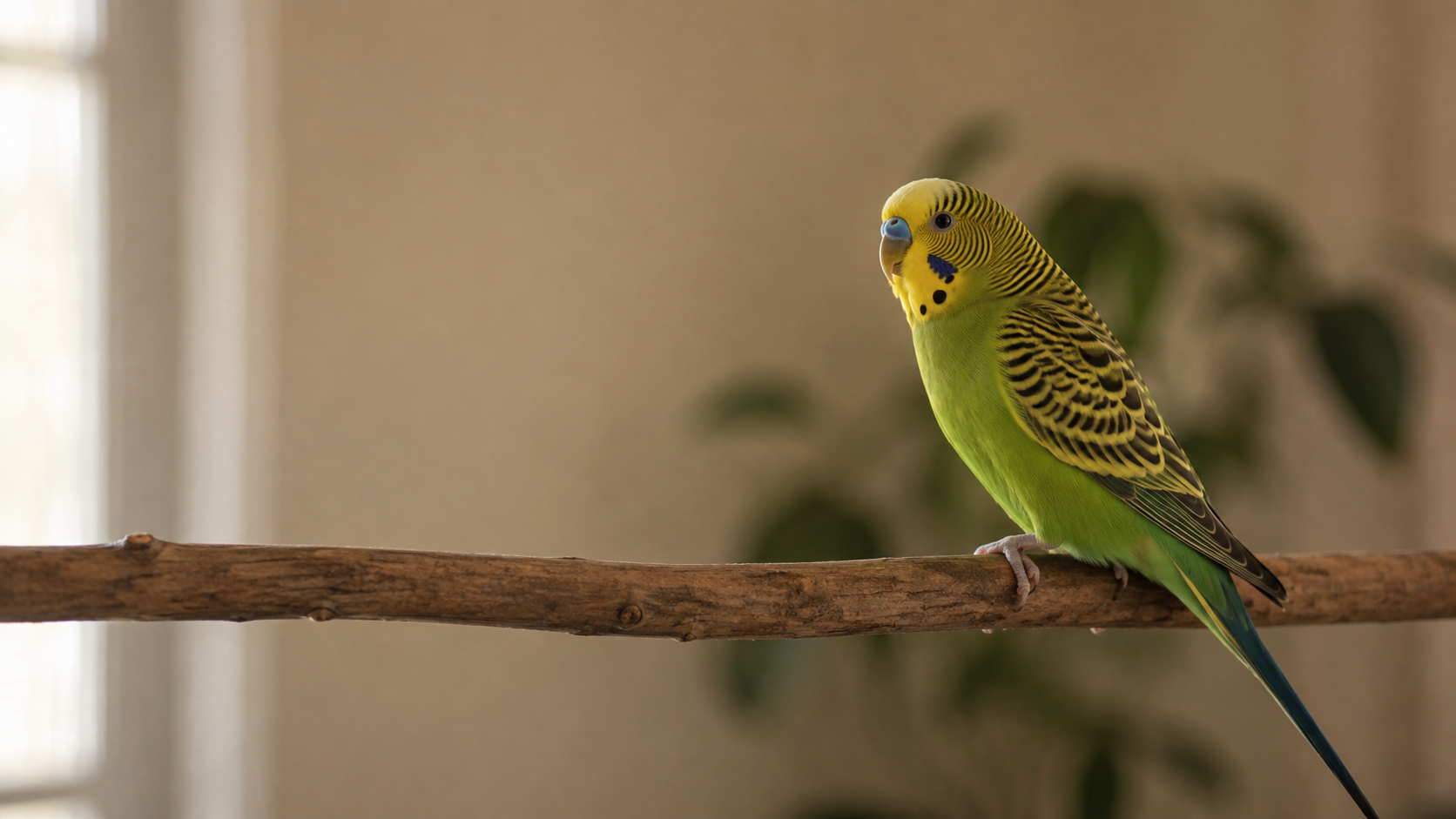
Budgerigar
The most underestimated talking bird on the planet.
Before anything else, we want to correct something that gets repeated everywhere. Budgies are the most common pet parrot, and because the bird itself has a low purchase price, people assume budgies are a cheap pet.
No parrot is cheap. A budgie needs a properly sized cage, a varied diet of fresh food rather than a seed bowl, a steady supply of toys they will destroy on purpose because destroying things is what a healthy beak does, and an avian vet who is not cheap either. The bird is the smallest expense you will have. Going in expecting a cheap pet is one of the most common reasons budgies end up neglected, rehomed, or living alone in a small cage for years.
What is true is that budgies are widely available and their care needs are the most manageable of any parrot. That is a real advantage for a first-time owner. It is not the same thing as cheap.
Now, the talking. Budgies genuinely are exceptional at it, and the evidence is stronger than most people realize.
The bird holding the Guinness World Record for the largest vocabulary of any bird ever is not a grey parrot or a macaw. It is a budgerigar named Puck, credited with an estimated 1,728 words (Guinness World Records). Before Puck, the record was also held by a budgie, Sparkie Williams, who knew 531 words and 383 sentences (Talking bird, referenced records).
The research supports it too. Budgerigars were among the most likely species to rearrange words into new combinations, with 39 percent of owners reporting their bird did this frequently, second only to sulphur-crested cockatoos (Benedict et al., 2022).
And in 2025, neuroscientists at NYU found that budgerigars have a region of the forebrain that organizes vocal production in a way strikingly similar to the human speech motor cortex, describing it as a kind of vocal keyboard the bird can play to produce a wide range of sounds (Yang & Long, 2025, Nature). Budgies are, so far, the only non-human animal shown to have this.
Budgie speech tends to be fast, quiet, and a little muttery, so it takes a trained ear to catch. But their voices are small, they forgive beginner mistakes, and the ceiling on what they can learn is remarkably high. If your main goal is a talking bird and you have never owned a parrot, this is a serious contender.
One note from the research: male budgies had larger word and phrase repertoires than females.
Cockatiel
Cockatiels are one of the best all-round first parrots we know of. They are gentle, expressive, and quieter than most parrots. That crest on top of the head tells you how your bird feels all day long, which makes them excellent teachers for a new owner learning to read body language.
On talking, set your expectations correctly. Cockatiels are whistlers more than talkers. The study confirmed they learn more human sounds than phrases (Benedict et al., 2022). Many learn tunes beautifully. Some learn words, usually males.
If you want a bird that whistles your favorite song back at you, this is your bird. If you want conversation, look elsewhere.
Monk Parakeet (Quaker Parrot)
Chatty, clever, and among the better talkers for their size. Quakers pack a lot of personality into a medium bird, and many develop a solid vocabulary with clear pronunciation.
One practical thing to check first: Quakers are illegal to own in several U.S. states, because escaped birds have established wild colonies. Check your state law before you fall in love with one.
Indian Ringneck (Rose-ringed Parakeet)
Famous for clear, crisp speech, and deservedly so. Ringnecks are sharp birds with a real gift for pronunciation.
Two honest cautions. The study found ringnecks were among the least likely species to use their words in appropriate contexts, with 32 percent never doing so (Benedict et al., 2022). Their speech is often clearer than it is meaningful.
Second, ringnecks go through a rough adolescent stage that blindsides new owners. Birds get nippy and difficult for a stretch. Owners who understand behavior ride it out. Owners who do not often rehome the bird right at that point, which is a large part of why so many ringnecks end up in rescues.
Senegal Parrot
A quieter option for people with neighbors. Senegals are much less loud than most parrots their size, and they are affectionate, engaged birds.
They talk moderately. Like cockatiels, they learn more sounds than phrases (Benedict et al., 2022). Expect a decent whistler with some words rather than a chatterbox.
Their main challenge is that they tend to bond intensely with one person, which needs managing from day one.
Amazon Parrots
Amazons are among the very best talkers in the parrot world, and they are also expressive, funny, and easy to read once you know what to look for.
The research backs the reputation. Yellow-headed amazons were the species most likely to use words in appropriate context, at 76 percent, and turquoise-fronted and yellow-naped amazons were among the most likely to rearrange words into new phrases (Benedict et al., 2022).
Here is the trade-off. Amazons are loud, they are strong, and they can be intense during breeding season. We would not call them a beginner bird for most households. But for someone who has done their homework, has space, and does not share a wall with a neighbor, an amazon is a spectacular companion.
Grey Parrot
The best talker there is, and the bird we would most often steer a beginner away from.
That is not a contradiction. Greys are extraordinarily intelligent and extraordinarily sensitive. They need enormous mental stimulation, they are prone to feather damaging behavior when their needs go unmet, and they notice everything.
Greys reward experience. If this is your first bird, we would gently suggest learning on a species that forgives more mistakes, and coming back to greys later. They will still be brilliant when you are ready.
Species Where You Should Expect Less Talking
We include these because people buy them expecting words and end up disappointed, which is unfair to the bird.
Sun conures showed very limited mimicry in the research, and 79 percent never rearranged words into new phrases, the highest rate of any species studied (Benedict et al., 2022). They are gorgeous, affectionate, and extremely loud.
Green-cheeked conures were also among the least likely to improvise with words, at 52 percent never doing so. They are wonderful, playful, cuddly birds. Just not talkers.
Pacific parrotlets showed very limited human mimicry.
Lovebirds learn more sounds than words, and half never rearranged what they learned.
None of that makes them lesser birds. It just means if talking is your priority, these are not the ones.
Talking Is Not Really About Vocabulary
Here is the finding from that study we find most interesting, and it changes what "a good talking bird" even means.
Across the whole sample, 89 percent of parrots used their mimicked words in appropriate human situations at least sometimes, without being prompted (Benedict et al., 2022). Most birds also rearranged words into new combinations they had never been taught.
That is not parroting. That is a bird noticing that a certain sound goes with a certain moment.
So a budgie with 12 words it uses at exactly the right times is doing something more impressive than a bird with 200 words it recites at random. Vocabulary size is the easy thing to count. It is not the interesting thing.
How Parrots Actually Learn to Talk
This part matters more than species choice, and it is the part almost nobody explains.
Parrots say things that are fun to say. By fun, we mean the consequence is rewarding for the bird. It gets your attention, gets a laugh, gets a smile, or gets a treat. Birds also talk most when they feel safe and comfortable, which is why a stressed or frightened bird often goes quiet.
That gives you a practical method:
Say the phrase more often. Birds repeat what they hear most. Pair it with fun and with your attention.
Reward any vocalization at first. If your bird makes any sound while you are together, give attention and a high value treat. You are teaching your bird that making sounds with you is worthwhile.
Then get selective. Once your bird is offering a sound reliably, stop rewarding that particular one. Your bird will try something slightly different, because the old one stopped working. The moment you hear something new, celebrate it and reward it. Your bird learns that experimenting with new sounds is the fun part, and you build from there.
There is another use for this that has nothing to do with vocabulary, and it may be the single most valuable thing in this article.
Wild parrots contact call constantly. They call out to their flock and their flock calls back, all day long, and that is how everyone knows the group is safe. Your bird will do this in your home too, because it is hardwired. In the wild, that call needs to carry across a forest.
You cannot remove that instinct. But you can shape what it sounds like. When your bird calls out, answer with a whistle, a word, or a short phrase at a normal volume. Over time many birds start using your quieter sound instead of the piercing one, because it works just as well at getting a response. Teaching a contact call is one of the most useful things a new owner can do, and it is far easier than fixing a screaming problem later.
What Owning One of These Birds Actually Involves
Now the part we would want someone to tell us.
This is a long commitment. Cockatiels commonly live into their teens and twenties. Amazons and greys can live for decades. This is not a pet you have for a few years. It is a companion you plan your life around, and you should have a written plan for who takes the bird if something happens to you.
The relationship needs daily work. People are told a parrot is a lifetime commitment because of how long they live. That is only half of it. It is a lifetime commitment because you have to work on that relationship daily, the same way you would with another person.
They are not domesticated. Dogs and cats have lived alongside us for thousands of years and have been shaped by that. Parrots have not. The bird in your living room has the same instincts as a wild bird, and hand-raising does not remove them.
They are as smart as a young child. Parrots solve problems at roughly the level of a five-year-old. That intelligence is not a feature that makes them low maintenance. It is a need. A brain like that has to be doing something, and if you do not give it a job, it will choose one. Usually screaming, destroying your woodwork, or plucking its own feathers.
Their welfare has several moving parts at once. Living space, diet, feather and body condition, socialization and vocalization, and mental stimulation. None of them is more important than the others, and problems in one show up in the others. A poor diet shows in the feathers. A cage that is too small shows in the behavior.
Most of the hard stuff is preventable. Biting, screaming, and plucking are rarely random. They are usually a bird telling you something in the only way it has left, after quieter signals went unnoticed. Learning to read those quieter signals is the entire game.
What We Would Tell a Friend Before They Bought a Bird
Two things.
Learn first, buy second. This is backwards for most people, who buy the bird and then start reading. We would flip it. Understanding how behavior works before your bird comes home means you set things up correctly from day one, rather than undoing habits later. It is far easier to prevent a screaming problem than to fix one, and the same is true of biting, plucking, and a bird that will only tolerate one person in the house.
Beak School offers courses on exactly this, covering how to read body language, how behavior actually works, and how to train a bird using positive, choice-based methods. You do not have to learn it from us. Good books, a knowledgeable avian vet, and a qualified trainer in your area will all get you there. What matters is that you learn it before the bird arrives, not after.
Consider adoption seriously. There are a lot of parrots in rescues, and most of them are there for reasons that had nothing to do with the bird. Adolescence caught someone off guard. An owner's life changed. Somebody bought a bird for its talking and got a quiet one.
Adopting an adult also removes the guesswork about personality. With a young bird you are hoping. With an adult, what you meet is what you get, including whether it talks.
The Beak School community has an adoption section where members connect birds that need homes with people who are ready for them. Local parrot rescues and avian vets are also good places to ask, and many of them will tell you honestly whether a particular bird is a fit for a first-time owner.
The Honest Bottom Line
If you want the best odds of a talking bird as a first-time owner, a budgerigar or a Quaker parrot will give you the most talking for the least difficulty. A cockatiel will give you a wonderful first bird and a great whistler. An amazon will give you spectacular speech if your household can handle the volume and you have done your homework.
But every bird on this list, and every bird not on it, can be a great companion. The species sets the odds. You set the outcome.
Pick the bird whose noise, size, and lifespan fit your actual life. Learn how behavior works before it comes home. And choose a bird you would love even if it never says a single word.
If it talks, that is a gift. It was never the point.
Sources
Benedict, L., Charles, A., Brockington, A. & Dahlin, C.R. (2022). A survey of vocal mimicry in companion parrots. Scientific Reports, 12, 20271. Survey of 877 companion parrots across 73 species, source of all repertoire, improvisation, contextual use, age, sex, and sociality findings cited above. Read it
Young, A.M., Hobson, E.A., Bingaman Lackey, L. & Wright, T.F. (2012). Survival on the ark: life-history trends in captive parrots. Animal Conservation, 15(1), 28-43. Lifespan context. Read it
Chalmers, S., Mullan, S., Robinson, N. & Green, M. (2024). What are the priority welfare issues facing parrots in captivity? A modified Delphi approach to establish expert consensus. Animal Welfare, 33, e56. Expert ranking of captive parrot welfare problems. Read it
Yang, Z. & Long, M.A. (2025). Convergent vocal representations in parrot and human forebrain motor networks. Nature, 640, 427-434. NYU Langone study identifying a humanlike vocal motor map in the budgerigar forebrain. Read it
Guinness World Records. Largest vocabulary for a bird, ever. Puck the budgerigar, an estimated 1,728 words. View record
Sparkie Williams, budgerigar, holder of the previous record with 531 words and 383 sentences between 1954 and 1962. Documented at the Hancock Museum, Newcastle. Background
Pepperberg, I.M. (2006). Cognitive and communicative abilities of Grey parrots. Applied Animal Behaviour Science, 100(1-2), 77-86. Read it
Training methodology and welfare framework in this article draw on the Beak School course library and webinar archive.
Nothing in this article is veterinary advice. For anything involving your bird's health, diet, or feather condition, please consult a certified avian veterinarian.