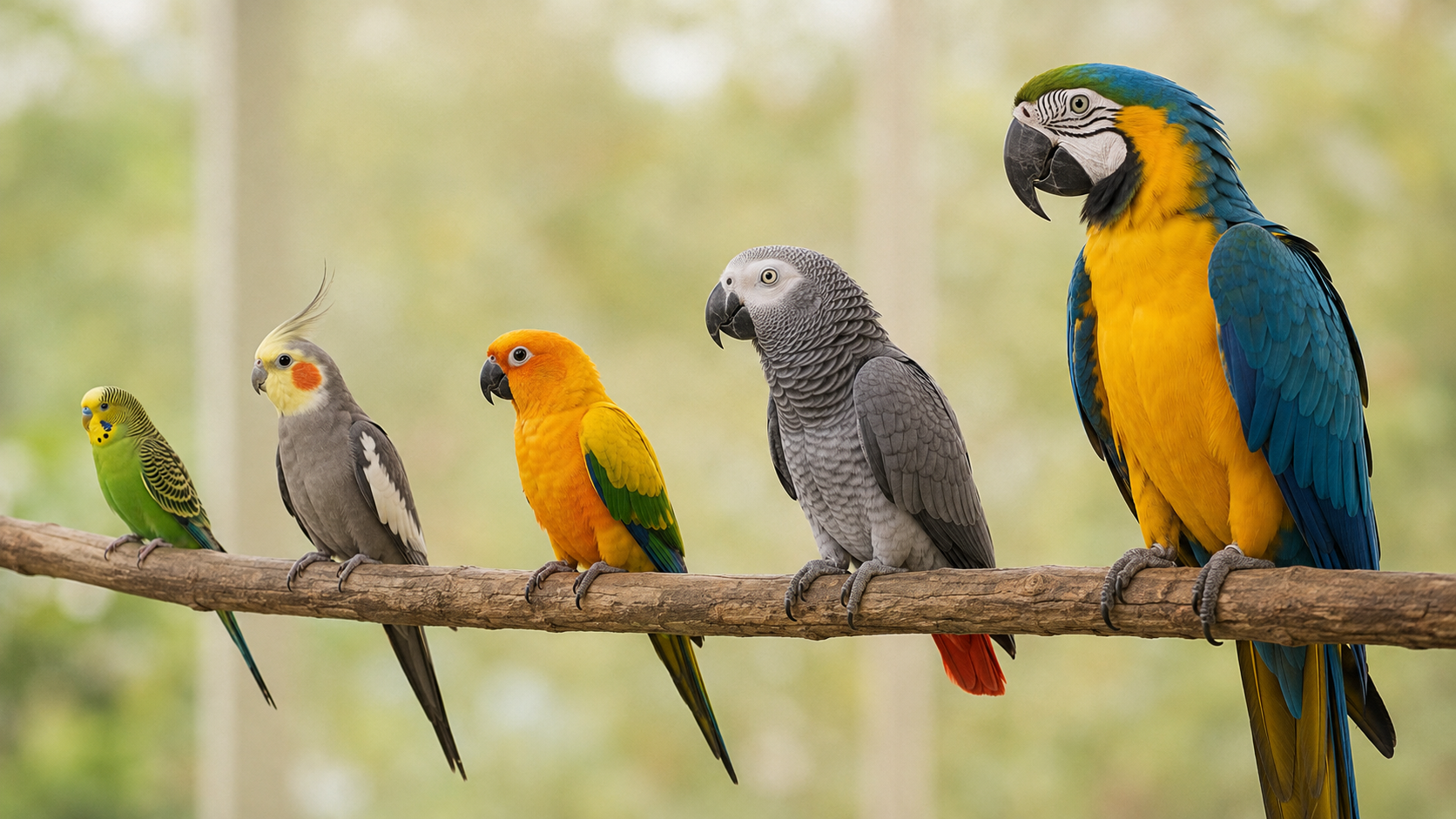
Search for the best parrots for pets and you will find a hundred lists. Most of them rank birds like used cars. This one is friendly. That one is loud. Avoid this species. Get that one instead. We want to tell you something different, and we have spent years watching it play out in real homes.
You will see a lifespan range with each species. Here is exactly where those come from, because most numbers floating around online are somebody's best guess.
They come from the largest study ever done on parrot lifespan, which analyzed 83,212 individual bird records covering 260 species, about 71 percent of all parrot species alive today (Young et al., 2012, Animal Conservation).
Each range has two ends, and they mean different things. The low number is the typical adult lifespan, meaning half the birds who reached adulthood lived longer than that and half lived shorter. The high number is the oldest individual ever recorded for that species.
Most charts online only show you the high number. That is the record, not the forecast. We are showing you both, and the space between them is going to matter a lot by the end of this article.
Small Parrots
Small does not mean simple. These birds have the same wiring as their big cousins, just in a smaller package.
Budgerigar (budgie, parakeet).Typically 6 years, up to 18 on record. The most popular pet bird on earth, and badly underestimated. Budgies are flock birds, wildly social, and many learn to talk with surprising clarity. They are cheap to buy, which sadly means they are often treated as disposable. A budgie who gets real attention, flight time, and training becomes an outstanding companion.
Cockatiel.Typically 7 years, up to 36 on record. Gentle, whistly, and expressive. That crest on top of the head is a live feed of how your bird feels, going up when alert or excited and flattening tight when scared or upset. Cockatiels are one of the best first parrots we know of, mostly because they forgive beginner mistakes while you learn.
Lovebird.Typically 7 years, up to 34 on record, based on peach-faced lovebirds. Small, bold, and full of opinions. Lovebirds have a reputation for nippiness, which mostly comes down to how much handling and training they got early on. They are not shy birds, and they will tell you exactly what they think.
Parrotlet.Typically 6 years, up to 30 on record, based on Pacific parrotlets. A macaw personality in a body the size of a lemon. Parrotlets are confident to the point of comedy. They need the same training as a big bird, because they absolutely do not know they are small.
Green-cheeked conure.No reliable published range. Playful, cuddly, quieter than most conures, and a huge favorite with families. We are not giving you a number here on purpose. The big lifespan study had only three records for this species, which is nowhere near enough to publish a range from. Anyone quoting you a confident green-cheek lifespan is guessing. Ask a certified avian vet instead.
Medium Parrots
This is the sweet spot for a lot of families. Big enough personality to feel like a real partnership, small enough not to overwhelm a household.
Senegal parrot and Meyer's parrot.Senegals typically 7 years, up to 27 on record. Meyer's typically 8 years, up to 31. Both come from the same African group. They are quieter than most parrots their size, which matters if you have neighbors. They tend to bond hard with one person, so early training with the whole family is important.
Monk parakeet (Quaker parrot).Typically 7 years, up to 25 on record. Chatty, clever, and among the better talkers for their size. Worth knowing that Quakers are illegal to keep in several U.S. states because escaped birds have formed wild colonies. Check your state before you fall in love.
Rose-ringed parakeet (Indian ringneck).Typically 8 years, up to 34 on record. Beautiful, sharp minded, and famous for clear speech. Ringnecks go through a rough patch in adolescence that catches new owners off guard. Owners who understand behavior sail through it. Owners who do not often rehome the bird right at that stage.
Pionus parrots.Typically 7 years, up to 23 on record, based on blue-headed Pionus. One of the most underrated groups in the hobby. Calm, steady, and much quieter than an amazon. If you want a medium parrot without the volume, look here.
Caiques.Typically 13 years, up to 27 on record, based on black-capped caiques. Little clowns with endless energy. They hop, they wrestle, they surf across the carpet. Caiques are not for someone who wants a calm bird sitting on a perch. They want a job.
Sun conure.Typically 11 years, up to 30 on record. Gorgeous, affectionate, and loud. Genuinely loud. A sun conure in a small apartment with thin walls is a hard combination. In the right home, they are devoted birds.
Large Parrots
These are the birds people picture when they think parrot. They are also the birds that most often end up rehomed, and it is almost never the bird's fault.
Grey parrot (African grey).Typically 8 years, up to 48 on record. Probably the most studied parrot on the planet. Nearly thirty years of published research on one grey named Alex showed abilities that stunned the scientific world. He learned to label colors, shapes, and sizes, understood same and different, recognized and named quantities up to six, and spontaneously demonstrated a grasp of the concept of none (Pepperberg, 2006, Applied Animal Behaviour Science). Greys are extraordinary. They are also sensitive, and surveys consistently find greys among the highest rates of feather damaging behavior of any pet parrot (Mahdavi et al., 2023, Applied Animal Behaviour Science). That combination is exactly why understanding behavior matters so much with this species.
Eclectus parrot.Typically 9 years, up to 41 on record. Males are brilliant green, females are red and purple, and the difference is so extreme that the two sexes were long mistaken for separate species. Eclectus are calm, thoughtful birds who tend to think before they act. They also respond badly to being pushed, which makes them wonderful teachers of patience.
Amazon parrots.Typically 10 to 11 years, up to 67 on record. Blue-fronted amazons top out around 37, yellow-naped amazons at 67. Bold, funny, and dramatic. Blue-fronted, yellow-naped, and yellow-headed amazons are among the best talkers in the parrot world. Amazons wear their emotions on the outside, with pinning eyes and flared tails, so they are easier to read than most birds once you know what to look for.
Cockatoos.Typically 9 to 11 years, but the records run enormously higher. Goffin's up to 30, umbrella up to 32, galahs and sulphur-cresteds up to 73, and Moluccans up to 93. Galahs, sulphur-crested, umbrella, Moluccan, and Goffin's are the ones you see most in homes. Cockatoos are affectionate to a degree that surprises people, and that same intensity is why they are the species most often surrendered. Goffin's cockatoos deserve special mention. In published studies they have invented and manufactured tools, and solved a task requiring two objects used in combination, leading researchers to conclude that the cognitive groundwork for composite tool use evolved outside the primate lineage (Osuna-Mascaró et al., 2022, Scientific Reports). A bird that clever will absolutely find a project if you do not give it one.
Macaws.Typically 13 to 18 years, the highest of any parrot group. Blue-and-golds up to 49 on record, scarlets 48, green-wings 63, hyacinths 54. Blue-and-gold, green-winged, scarlet, and hyacinth are the big ones. Hahn's and severe macaws are the smaller versions with the same big personality. Macaws are powerful, smart, loud, and long lived. In the largest captive lifespan study ever done, the macaw group had the highest median adult lifespan of any major parrot clade (Young et al., 2012, Animal Conservation). Bringing one home is a decades-long commitment, sometimes a lifelong one.
What Those Ranges Actually Tell You
Go back and look at the two numbers for the cockatoos.
Typically nine to eleven years. On record, up to ninety-three.
That is not a small gap. That is an entire lifetime sitting in the middle of it, and the same pattern shows up across the whole order. Galahs, typically nine, recorded at seventy-three. Grey parrots, typically eight, recorded at forty-eight. Yellow-naped amazons, typically eleven, recorded at sixty-seven.
Here is the rough shape of it by size, so you have something to plan around.
Small parrots like budgies, cockatiels, lovebirds, and parrotlets typically live six to seven years, with records reaching into the twenties and thirties. Medium parrots like Senegals, Quakers, ringnecks, Pionus, caiques, and sun conures typically live seven to thirteen years, with records in the twenties and thirties. Large parrots like greys, eclectus, amazons, cockatoos, and macaws typically live eight to eighteen years, with records stretching from the forties well past ninety.
Notice something. The typical numbers are much closer together than most people expect. A macaw does not typically live six times longer than a budgie. The dramatic difference between species is not in the typical lifespan at all. It is in the ceiling.
We are not showing you this to scare you off. We are showing you because that gap is the entire point of this article.
The researchers who gathered this data said it plainly. Cockatoos have the biological potential to live a very long time, and few individuals are realizing that potential in captivity. Their recommendation was research aimed at improving husbandry and welfare (Young et al., 2012).
In plain English, the top of the range is set by biology. Where your bird actually lands inside that range has a great deal to do with us.
The Smarter the Bird, the More Training Matters
Here is something people get backward.
They assume a smarter parrot is an easier parrot. It is the opposite. Intelligence is not a feature that makes a bird low maintenance. Intelligence is a need. A brain like that has to be doing something, and if you do not give it a job, it will pick one. Usually the job it picks is screaming, chewing your cabinets, or pulling out its own feathers.
The research backs this up hard. When scientists raised young Amazon parrots with foraging opportunities and a physically complex environment, those enrichments both prevented feather picking from starting and reduced it in birds who had already begun (Meehan, Millam & Mench, 2003, Applied Animal Behaviour Science). Same species, same setup. Change the environment, change the behavior.
A companion study found that parrots raised with those same enrichments were significantly less fearful of both novel objects and unfamiliar human handlers (Meehan & Mench, 2002, Applied Animal Behaviour Science). Not braver by luck. Braver by setup.
And here is a detail worth sitting with. Feather damaging behavior shows up in an estimated ten to twenty percent of pet parrots overall, with surveys reporting far higher rates in greys and cockatoos (Mahdavi et al., 2023). Researchers also note that the behavior is not seen in wild parrots, which points to a gap between what these birds need and what typical captive homes provide, rather than a defect in any species.
Which brings us to the thing every good parrot home is built on.
The ABCs of Parrot Behavior
Trainers call it the ABCs of behavior. It stands for Antecedent, Behavior, and Consequence. Every certified animal trainer on earth learns these three words.
Inside our courses we use those real terms, and you will hear "antecedent" from us plenty. It is the language every trainer and behavior professional shares, and we want you fluent in it. But nobody says "antecedent" at the dinner table. So while you are learning, here is a plain English handle for each letter:
A is the Setup [Antecedent]. Everything happening right before your bird does the thing.
B is the Behavior [Behavior]. What your bird actually does, that you can see with your own eyes.
C is the Payoff [Consequence]. What happens right after, and whether your bird liked it.
The Setup. The Behavior. The Payoff. Three beats, like a little story, and it plays out hundreds of times a day in your living room. Learn it by the plain names first. The formal ones will feel easy by the time you need them.
The Setup is the scene. Who walked in the room. Whether the dog trotted past. Whether the sun had gone down. Whether it is the time of year when your bird's body chemistry changes. Whether you came flying in with a hand before your bird was even awake. Most people only pay attention to the bite, because the bite hurts. But the bite is the end of the story. The setup is the beginning, and the beginning is where all your power is.
The Behavior is only what you can see. Feathers slicked flat. Feathers fluffed soft. Eyes flashing. A foot that did not lift. A body leaning away. A bird sliding to the far end of the perch. Notice what is not on that list. Jealous is not on it. Spiteful is not on it. Stubborn is not on it. Those are stories we tell about what we see, and the second you label a bird, you have closed the door on helping it.
The Payoff runs the whole machine. If your bird liked what happened afterward, your bird will do it again. If not, your bird will try something else next time. Simple as that, and true for every animal alive, including you.
Here is where people trip. The payoff is decided by the bird, not by you. Your bird screams, you march over and say knock it off, and you think you punished him. But wild parrots call out and their flock calls back. That is how they know everyone is safe. From your bird's side, he called and his favorite person came and answered. That worked beautifully. He will do it again tomorrow.
You thought you were scolding. He heard you answering.
Why This Comes Before Everything Else
There is an old-fashioned way of handling parrots. Make the bird step up anyway. Show him who is boss. Push through the bite.
Here is what that actually teaches. Your bird leaned away and the hand kept coming. He put his head down and the hand kept coming. He moved to the end of the perch and the hand kept coming. So all his quiet signals stopped working, and he learned there is exactly one thing that makes a hand back off.
The bite.
We just trained a biter, and then we blamed the bird for it.
The ABCs give you a completely different road. Understand the setup and you stop walking your bird into situations that end in bites. Read behavior and you catch the whisper long before anyone has to shout. Understand the payoff and you make the right choices so rewarding that your bird starts offering them on his own, because he wants to, not because he was cornered.
That is what ethical parrot training means. Not special equipment. Not secret tricks. Just this: the bird is a willing partner.
And it is not only kinder. It is what the numbers say works. Remember that giant lifespan gap? Better welfare is what closes it.
So Which Parrot Is Best for You?
Now we can answer the actual question, and it has nothing to do with rankings.
Ask about noise before anything else. A sun conure or a cockatoo in an apartment with shared walls is a hard road. A Pionus, a Senegal, or a cockatiel is far more neighbor friendly.
Ask about time. Not money, time. Every parrot needs daily interaction, out-of-cage time, and something to work on. The big smart species need more of it, not less.
Ask about the calendar. Plan for the top of the range, not the typical number. A cockatiel in a good home is a decades-long commitment. A macaw may outlive you, and you need a written plan for who takes over.
Ask who else lives in your house. Small children and large beaks need careful management. Not impossible. Just planned.
Then ask the real question. Are you willing to learn how behavior works? A survey of owners of 2,200 parrots found that birds rated by their owners as more neurotic and less prosocial were the ones those owners intended to rehome (Grant et al., 2024, Applied Animal Behaviour Science). That study measured owner perception rather than cause, so it cannot tell us why those birds ended up rated that way. What it does tell us is that how a bird behaves at home, and how the owner reads that behavior, is closely tied to whether the bird gets to stay.
The best parrot for you is the one whose noise level, size, and lifespan fit your real life. And then the best parrot owner is the one who learned to listen.
Where to Start
Here is your first assignment, and it costs nothing. For one week, just watch. When your bird does anything, good or bad, ask three questions. What was the setup? What exactly did I see, in plain observable terms? And what was the payoff, from my bird's point of view?
Do not fix anything yet. Just watch. Patterns will start jumping out at you within days.
If you are already dealing with something hard, a bird who bites, screams for hours, or pulls out feathers, please hear us. You are not a bad owner and your bird is not a bad bird. You have been missing the pattern, and patterns can be found.
You do not have to do it alone either. You can look for a qualified parrot trainer in your area who uses positive, choice-based methods. Or, if you would rather learn at your own pace from your own couch, our online courses at beakschool.com were built for exactly this. Each one takes one specific problem and walks you through it step by step, using everything you just read here.
Every parrot can be a good pet. The bird was never the hard part.
Sources
Every research claim above links to its source. Full references:
Chalmers, S., Mullan, S., Robinson, N. & Green, M. (2024). What are the priority welfare issues facing parrots in captivity? A modified Delphi approach to establish expert consensus. Animal Welfare, 33, e56. Read it
Young, A.M., Hobson, E.A., Bingaman Lackey, L. & Wright, T.F. (2012). Survival on the ark: life-history trends in captive parrots. Animal Conservation, 15(1), 28-43. Read it. Both ends of every lifespan range in our chart come from this study. The low number is the median adult lifespan for birds that survived past age four. The high number is the maximum lifespan on record for that species.
Meehan, C.L., Millam, J.R. & Mench, J.A. (2003). Foraging opportunity and increased physical complexity both prevent and reduce psychogenic feather picking by young Amazon parrots. Applied Animal Behaviour Science, 80(1), 71-85. Read it
Meehan, C.L. & Mench, J.A. (2002). Environmental enrichment affects the fear and exploratory responses to novelty of young Amazon parrots. Applied Animal Behaviour Science, 79(1), 75-88. Read it
Pepperberg, I.M. (2006). Cognitive and communicative abilities of Grey parrots. Applied Animal Behaviour Science, 100(1-2), 77-86. Read it
Osuna-Mascaró, A.J., Mundry, R., Tebbich, S., Beck, S.R. & Auersperg, A.M.I. (2022). Innovative composite tool use by Goffin's cockatoos (Cacatua goffiniana). Scientific Reports, 12, 1373. Read it
Grant, R.A., Greenwell, P. & Kolubinski, D. (2024). Owner-rated personality in companion parrots (Aves; Psittaciformes): a four dimension model. Applied Animal Behaviour Science, 279, 106387. Read it
Mahdavi, A. et al. (2023). Prevalence and risk factors of feather damaging behavior in companion parrots: a cross-sectional study in Iran. Applied Animal Behaviour Science. Read it
Olah, G. et al. (2016). Ecological and socio-economic factors affecting extinction risk in parrots. Biodiversity and Conservation, 25, 205-223. Read it
Nothing in this article is veterinary advice. For anything involving your bird's health, including sudden feather loss, appetite changes, or a bird who has stopped eating treats, please see a certified avian veterinarian.