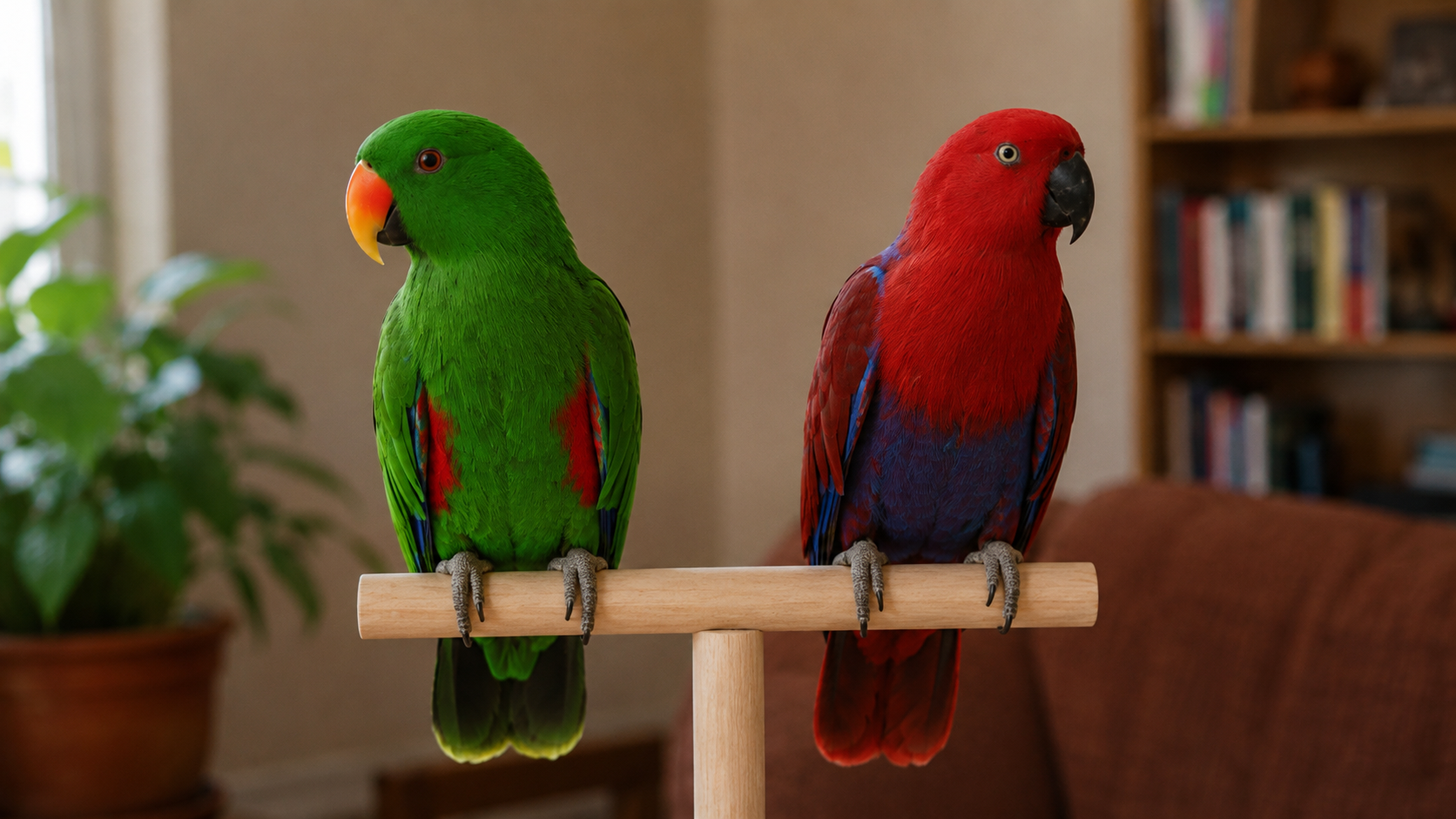
For the eclectus parrot, AnAge lists a maximum longevity of 28.5 years in captivity. That record belongs to a single bird that lived at the San Diego Zoo, and the entry even notes that this bird stopped breeding four years before it died. The original record comes from a review of longevity records for parrots published in the International Zoo Yearbook.
That is the number that has actually been checked.
Search this question and you will get a fast, confident answer. Thirty to fifty years. Sometimes longer. Nearly every pet site says some version of it.
We went looking for where that number comes from. What we found was more complicated, more honest, and frankly more useful to anyone who owns one of these birds.
Here is the short version. The single longest eclectus life that has been properly verified is 28.5 years (AnAge, Human Ageing Genomic Resources). The higher numbers you see quoted everywhere have not been confirmed. And the typical eclectus in the largest dataset ever assembled lived nowhere near either figure.
That gap is not bad news. It is the most important thing an eclectus owner can understand, and this article is about why.
The Verified Record: 28.5 Years
The most careful source on animal lifespans is the AnAge database, part of the Human Ageing Genomic Resources project at the University of Liverpool. AnAge does not simply collect claims. It rates each entry for data quality and flags anything it cannot confirm.
For the eclectus parrot, AnAge lists a maximum longevity of 28.5 years in captivity. That record belongs to a single bird that lived at the San Diego Zoo, and the entry even notes that this bird stopped breeding four years before it died. The original record comes from a review of longevity records for parrots published in the International Zoo Yearbook.
That is the number that has actually been checked.
The 40-Year Figure, and Why It Comes With an Asterisk
You will also see 40 years quoted. That figure is real, and it comes from a serious study, but it needs context.
In 2012, researchers analyzed 83,212 individual parrot records from zoos and animal collections worldwide, covering 260 species, roughly 71 percent of all parrot species alive (Young et al., Animal Conservation). It is the largest study of captive parrot lifespan ever done. For eclectus parrots, that dataset held 2,521 individual birds, and the oldest of them reached 40.76 years.
Here is the part almost nobody quotes. AnAge looked at that same 40.8 year figure and marked it as not verified.
That is not an accusation against the study. Zoo record keeping across hundreds of institutions over two centuries is messy. Birds get transferred between collections, hatch dates get estimated, and paperwork goes missing. The researchers themselves said as much, warning that some questionable values remain in the data and that care should be taken in generalizing from it.
So we have one carefully confirmed record at 28.5 years, and one larger but less certain record at 40.76. Both are real numbers. Neither one is a forecast for your bird.
The Number Nobody Puts on a Website
Now for the figure that actually matters, and the one you will almost never see.
In that same study of 2,521 eclectus parrots, the researchers calculated the median lifespan for birds that survived past age four. Median means the middle. Half lived longer, half lived shorter.
That number was 9 years.
For eclectus that were still alive when the data was pulled, the median age was 10.1 years.
Read those two numbers again next to the headline figure. A record of forty years. A typical life of nine.
This pattern is not unique to eclectus. The researchers found it across the whole parrot order and stated it plainly: median lifespans are generally shorter than widely assumed. Only about thirty percent of the 260 species they studied had a median adult lifespan of ten years or more, even after setting aside young birds who died early.
So Which Number Is Right?
All of them. They are answering different questions.
Think of it like asking how long a person lives. You could point to the oldest documented human, who reached 122. That is true. It is also useless for planning your life.
The record tells you what the species is biologically capable of. The median tells you what actually tends to happen. The distance between them is the interesting part, because that distance is not fixed by biology. It is where care lives.
One More Wrinkle: They Are Not One Species Anymore
There is a complication worth knowing about, because it affects every lifespan number published before about 2023.
For most of the last century, all eclectus parrots were treated as one species, Eclectus roratus. In 2023 the International Ornithological Congress split them into four separate species, following a change the IUCN and BirdLife International had already made (World Parrot Trust species encyclopedia). Today there is the Moluccan eclectus, the Papuan eclectus, the Sumba eclectus, and the Tanimbar eclectus.
The birds people keep as pets, often sold under names like Solomon Island or Red-Sided, largely fall under the Papuan eclectus now.
Why this matters: every lifespan study we have cited counted all of these birds together as one species. Nobody has yet published separate lifespan data for the four. So when you read "eclectus lifespan," you are reading a number averaged across birds that scientists no longer consider the same species.
That is not a reason to distrust the figures. It is a reason to hold them loosely.
Why Eclectus May Struggle More Than Other Parrots
Here is where it gets specific to this bird, and where owners have real influence.
Eclectus are specialists. Almost everything that is true of parrots in general needs adjusting for them.
Their digestive system is different. Eclectus have an unusually long digestive tract, adapted for a wild diet extremely rich in fiber, and ecological studies suggest fruit can make up as much as eighty percent of what they eat in the wild. Veterinary nutrition guidance treats them as one of the few psittacine species for which fruit is a genuine dietary requirement rather than a treat, alongside lories (Today's Veterinary Nurse, avian nutrition review).
Their vitamin needs are unusual. Veterinary literature presented at the World Small Animal Veterinary Association congress notes that eclectus parrots have increased vitamin A requirements, should have minimal seed in the diet, and may be sensitive to colorants and preservatives in formulated diets. That long digestive tract cuts both ways: it absorbs more, which means over-supplementing is a real risk, not just under-feeding.
We want to be careful here, because this is where a blog post can do harm. We are not going to hand you a feeding plan. Eclectus nutrition is genuinely specialized, individual birds differ, and getting it wrong in either direction causes problems. If you own an eclectus, this is a conversation to have with a certified avian veterinarian who has experience with the species. Not a general small animal vet, and not a website.
Their behavior is demanding in ways owners do not expect. Unlike most parrots, eclectus in the wild breed year round rather than in one defined season. That breeding behavior does not switch off in a living room, and it can make hormonal behavior a constant management job rather than a few difficult months. Eclectus are also frequently affected by feather destructive behavior, which their unusual hair-like feather structure makes harder to spot early, because you cannot easily see whether a feather was chewed or broken the way you can on other species.
None of that means eclectus make bad pets. We do not believe any parrot species does. It means this bird asks more of its owner than most, and the lifespan numbers reflect how often that ask goes unmet.
What This Means If You Own One
Take the range seriously in both directions.
Plan for the long end. If your eclectus lives near the documented ceiling, you are looking at a bird that could be with you for two to four decades. That is a written plan for who takes over if something happens to you. It is not morbid, it is responsible. When 26 parrot welfare experts were asked to rank the biggest welfare problems captive parrots face, the lack of a life plan for the bird made their top ten list (Chalmers et al., 2024, Animal Welfare).
Do not treat the short end as fate. A typical recorded lifespan of nine years is a description of what has been happening, not a prediction of what must happen. Zoo record keeping shows lifespans climbing as husbandry improves. The birds alive in those collections when the data was pulled were significantly older, on average, than the historical median, and the researchers credited advances in animal husbandry.
Understand that the ceiling is biology and the floor is us. That was the conclusion the researchers reached about parrots generally, and their recommendation was long-term research aimed at improving husbandry and welfare. In plain terms, the top of the range is set by the species. Where a bird actually lands inside that range has a great deal to do with the home it lives in.
The Honest Answer
If someone asks how long eclectus parrots live, here is an answer you can give without overstating anything:
The verified record is 28.5 years, with a less certain record of about 41 years from a large zoo dataset. In that same dataset, covering more than 2,500 birds, the typical adult lived around 9 to 10 years. A well-cared-for eclectus in a modern home should reasonably be expected to land well above that median, and owners should plan for a commitment measured in decades.
That is less tidy than "thirty to fifty years." It is also true.
Where to Go From Here
If you own an eclectus and want to give yours the best shot at the long end of that range, two things matter more than anything else.
Build a relationship with a certified avian veterinarian who knows this species. Eclectus health and nutrition are specialized enough that general advice, including ours, is no substitute for someone who can examine your actual bird.
And learn how behavior works. Most of what shortens a parrot's life in a home is not a single dramatic event. It is a slow accumulation of stress, boredom, and misread signals that eventually shows up as feather damage, chronic hormonal behavior, or a bird surrendered to a rescue. Understanding what your bird is telling you is the first step, and it is the foundation everything else is built on.
You can look for a qualified parrot trainer in your area who uses positive, choice-based methods. Or if you would rather learn at your own pace from home, our courses at beakschool.com were built for exactly this.
Your eclectus is capable of being with you a very long time. How long is partly up to you.
Sources
AnAge: The Animal Ageing and Longevity Database, Human Ageing Genomic Resources. Eclectus parrot entry, maximum longevity and data quality rating. View entry
Young, A.M., Hobson, E.A., Bingaman Lackey, L. & Wright, T.F. (2012). Survival on the ark: life-history trends in captive parrots. Animal Conservation, 15(1), 28-43. Source of the 2,521 eclectus records, the 9-year median adult lifespan, and the 40.76-year maximum. Read it
Brouwer, K., Jones, M.L., King, C.E. & Schifter, H. (2000). Longevity records for Psittaciformes in captivity. International Zoo Yearbook, 37, 299-316. Original source of the verified 28.5-year San Diego Zoo record. Read it
International Ornithological Congress / BirdLife International. 2023 taxonomic split of Eclectus roratus into four species. Species overview
World Small Animal Veterinary Association (WSAVA) 2014 Congress, Recognising Avian Malnutrition. Notes increased vitamin A requirements and seed sensitivity in eclectus. Read it
Chalmers, S., Mullan, S., Robinson, N. & Green, M. (2024). What are the priority welfare issues facing parrots in captivity? A modified Delphi approach to establish expert consensus. Animal Welfare, 33, e56. Read it
Nothing in this article is veterinary advice. For anything involving your bird's health, diet, or feather condition, please consult a certified avian veterinarian.